1. Terminology and Scope
This paper employs several unconventional terms to describe the phenomena under investigation. By "intercalation" we mean a passage inserted into an existing text, often between layers of authentic material, without regard for original context. This term is preferred over "interpolation" because it emphasizes the artificial, layer-like quality of the insertion. By "larding" we refer to the process of adding extraneous, often fatty material (here, Torah-centric verses) to a leaner original text. "Mosaic plagiarism" denotes both the borrowing from the books of Moses and the patchwork, fragment-assembled nature of the final product.
The collection of Hebrew scriptures that later traditions call the "Old Testament" is, in fact, a hand-picked selection of Torah books, alien to the original Christian faith. The term "Old Testament" presupposes a "New Testament" as its fulfillment - a theological claim that this paper rejects. Accordingly, except when quoting sources that use the term, we will refer to this collection as "the Torah" or "the Torah books." When necessary for clarity, we will add "(misleadingly called the 'Old Testament')" at first mention.
2. Introduction: A Persistent and Unresolved Problem
The integrity of the Pauline epistles has been a matter of dispute since the second century. When Marcion of Sinope published the first collected edition of Paul's letters - the Apostolikon - it contained ten epistles in a form noticeably shorter than the canonical versions that would later prevail.¹ Patristic opponents, notably Tertullian and Epiphanius, accused Marcion of mutilating the texts by deleting passages that linked Christ to the Yahweh deity of the Torah.² Yet their accusations inadvertently preserved the evidence: the Apostolikon lacked precisely those verses that anchor Jesus to Abraham, to the Mosaic Law, and to Davidic lineage. The resulting canonical text is a palimpsest - a manuscript whose original, shorter layer has been scraped away and written over, yet still legible beneath.
The question of whether these verses were original to Paul or added later by proto-orthodox scribes has never been satisfactorily resolved. Mainstream scholarship has often deferred to the canonical text as the standard, treating Marcion's version as a secondary, heretical corruption. Yet a growing body of critical work has argued that the Apostolikon represents a more primitive textual stratum, and that the longer readings of the canonical epistles are expansions, not the result of deletion.³
This paper does not attempt to settle every dispute about Pauline authorship. Instead, it focuses on seven specific passages that are absent from the Apostolikon and that, when examined closely, reveal a consistent theological function: each of these passages binds the gospel of Christ to the covenant, law, or lineage of Yahweh. The cumulative weight of this evidence points to a deliberate, coordinated effort - what we will call the Theophanic Replacement Protocol - to replace the original, law-free revelation of the Father with a synthesized religion that worships the deity of the Torah under the name "Father."
3. The Primitive Scriptural Baseline: The Apostolikon
Before examining the seven intercalations, it is necessary to establish the textual baseline against which they are measured. The Apostolikon is the earliest known collection of Paul's letters. It was published in a single codex in 144 CE by Marcion of Sinope, a shipowner who retraced Paul's missionary journeys and gathered the original scrolls from the Pauline churches. His role was that of a transcriber, archivist, and publisher - not an author or editor. The prologues he wrote to accompany the epistles (preserved in Latin manuscripts, including the Vatican Library's Biblioteca Apostolica Vaticana) are separate historical notes, valuable sources but not part of the core scripture.⁴
The Apostolikon contains ten epistles: Galatians, 1 Corinthians, 2 Corinthians, Romans, 1 Thessalonians, 2 Thessalonians, Laodiceans (Ephesians), Colossians, Philemon, and Philippians. It does not contain the Pastoral Epistles (1 & 2 Timothy, Titus) or the Epistle to the Hebrews. Its text of Galatians and Romans lacks the Abrahamic arguments, the "born of a woman, born under the law" phrase, and the "descended from David according to the flesh" claim.
The canonical New Testament that emerged from the fourth-century councils is a different collection. It contains seven passages that are absent from the Apostolikon. The relationship between the two collections is that of a palimpsest: the later orthodox text was written directly over the earlier Pauline corpus, preserving the original's structure while altering its theology. These are the seven intercalations:
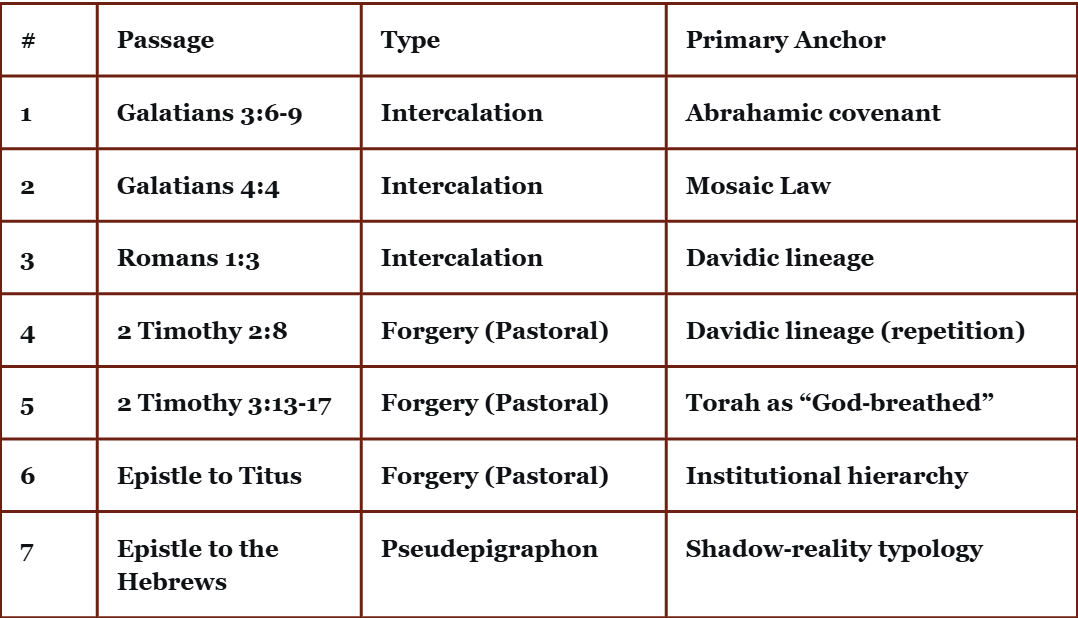
These seven intercalations are not independent; they form a closed theological cage. The analysis that follows demonstrates, for each, the textual disparity, patristic and scholarly corroboration, and the function of binding the gospel to the Torah.
4. The Seven Intercalations: Identification and Function
4.1 Intercalation #1 - Galatians 3:6-9 (Abrahamic Covenant Insertion)
Textual Comparison:
Apostolikon: after appealing to the Galatians' experience of the Spirit, Paul writes: "Learn that the righteous by faith shall live." There is no mention of Abraham, no quotation of Genesis 15:6, and no reference to "children of Abraham."
Canonical text (KJV): "Even as Abraham believed God, and it was accounted to him for righteousness. Know ye therefore that they which are of faith, the same are the children of Abraham. And the scripture, foreseeing that God would justify the heathen through faith, preached before the gospel unto Abraham, saying, In thee shall all nations be blessed. So then they which be of faith are blessed with faithful Abraham." (Galatians 3:6-9)
Patristic Evidence:
Tertullian, Against Marcion 5.4, states that the Apostolikon omitted these verses "in order to get rid of the mention of Abraham, and of the gospel having been preached to him."⁵ Jerome, in his commentary on Galatians, confirms the same: "From this point all the way up to where it is written 'they which are of the faith, are blessed with faithful Abraham' (v. 9), Marcion erased from his apostle..."⁶ These are adverse witnesses: they testify that the Apostolikon did not contain Galatians 3:6-9.
Scholarly Evidence:
John Knox argued that Marcion's canon represents an earlier stage of Pauline transmission and that the Catholic text systematically expanded the original Pauline core, particularly with respect to Abrahamic arguments.⁷ Joseph B. Tyson confirms that "the received text thus emphasizes Jewish lineage ('sons of Abraham' = 'children of faith'), whereas Marcion's simply speaks of 'faith' without the Abrahamic tie."⁸ James D. G. Dunn notes the abruptness of the Abrahamic argument and its formal, almost creedal character - observations that supply the stylistic data making the interpolation hypothesis plausible.⁹ Jason BeDuhn's reconstruction confirms the absence of Galatians 3:6-9, noting that the Marcionite text moves directly from the rhetorical questions of verses 1-5 to the statement about righteousness by faith without any intervening appeal to Abraham.¹⁰
Theological Function:
The insertion anchors the Gentile mission to the Abrahamic covenant. The original Apostolikon grounds salvation in faith alone, without any link to the patriarch. The added verses force Paul to say that believers are "children of Abraham" and that the gospel was "preached beforehand" to Abraham. This retroactively incorporates the new revelation into the old covenant narrative - exactly the "leading away into the law and the prophets" that the Marcionite prologue to Romans warns about.¹¹
4.2 Intercalation #2 - Galatians 4:4 (The Law Graft)
Textual Comparison:
Apostolikon: "When the fullness of time had come, God sent his Son."
Canonical (KJV): "When the fullness of the time was come, God sent forth his Son, made of a woman, made under the law."
Patristic and Scholarly Evidence:
Tertullian (Against Marcion 5.3) testifies that the Apostolikon lacked the phrase "made of a woman, made under the law."¹² BeDuhn confirms this absence and notes that the shorter reading is earlier.¹³ Dunn observes that the verse has "an almost creedal quality," suggesting it may be a traditional formula later inserted.⁹
Theological Function:
The added phrase performs a double graft: "made of a woman" ties the Son to Yahweh's creation; "made under the law" ties the Son to Yahweh's covenant. This directly contradicts Paul's celestial Christology in 1 Corinthians 15:31-34, where the "second man is from heaven" and "flesh and blood cannot inherit the kingdom."
4.3 Intercalation #3 - Romans 1:3 (Davidic-Flesh Graft)
Textual Comparison:
Apostolikon: opens with a greeting and thanksgiving; no mention of David, flesh, or prophets.
Canonical (KJV): "Concerning his Son Jesus Christ our Lord, which was made of the seed of David according to the flesh."
Theological Function:
"Made of the seed of David according to the flesh" anchors Jesus to Yahweh's royal covenant with Israel. The authentic Paul preaches a celestial "second man from heaven." The Davidic-flesh claim is a direct contradiction.
The Original Gospel's Rejection of Davidic Sonship
The contradiction becomes even more acute when we examine a dominical saying preserved in the Evangelion and, in slightly different forms, in the Synoptic Gospels. In Evangelion 16:4, Jesus explicitly argues against the notion that the Christ can be David's literal son:
"And he said unto them, How say they that the Christ is David's son? And David himself said in the book of Psalms, The LORD said unto my Lord, Sit on my right hand, till I make your enemies the footstool of your feet. David therefore calls him Lord, and how is he then his son?"¹⁶
The same tradition appears in the canonical Gospels (Mark 12:35-37; Luke 20:41-44; Matthew 22:41-45). Its logic is simple and unassailable: David calls the Messiah "Lord," a term of superior authority. A father does not call his son "Lord." Therefore, the Christ cannot be David's son in any literal, fleshly sense.¹⁷ The Evangelion - the original gospel - thus explicitly rejects the Davidic-flesh Christology. The later intercalation of Romans 1:3 is not merely an addition; it is a direct counter-teaching to a dominical saying preserved in the same canon. The orthodox redactors could not delete the Psalm 110 saying (it was too widely known), so they chose to ignore its logical force and simply larded the Davidic-flesh claim into the Pauline corpus. The result is an irreconcilable seam: Jesus himself denies being David's son, while the interpolated Paul affirms it.¹⁸
Scholarly Evidence:
John Knox argued that Marcion's text of Romans lacked the entire Abrahamic argument of Romans 4, which is closely tied to the Davidic claim of Romans 1:3.⁷ Joseph B. Tyson places the addition of such passages in the context of the second-century struggle against Marcionite Christianity.⁸ Jason BeDuhn's reconstruction of Marcion's Romans confirms the absence of Romans 1:3.¹⁴
4.4 Intercalation #4 - 2 Timothy 2:8 (Forged Repetition)
Textual Evidence:
Apostolikon: the Pastoral Epistles are entirely absent (Tertullian, Epiphanius).¹⁹
Canonical (KJV): "Remember that Jesus Christ of the seed of David was raised from the dead according to my gospel."
Scholarly Consensus:
BeDuhn classifies the Pastoral Epistles as pseudepigrapha, reflecting a second-century church structure foreign to Paul.²⁰ Bart Ehrman similarly argues that the Pastorals are non-Pauline forgeries.²¹
Theological Function:
The verse repeats the Davidic claim in a letter that attacks "profane and vain babblings" - coded language for the original, law-free gospel. The repetition is designed to make the Davidic anchor appear apostolic and widespread.
4.5 Intercalation #5 - 2 Timothy 3:13-17 (Torah-Authority Declaration)
Textual Evidence:
Apostolikon: Pastorals absent.
Canonical (KJV): "From a child thou hast known the holy scriptures… All scripture is given by inspiration of God."
Scholarly Evidence:
BeDuhn notes that "holy scriptures" (ἱερὰ γράμματα) refers exclusively to the Torah; there was no New Testament canon when this was written.²²
Theological Function:
This verse is the constitutional document of the adulteration: it declares the Torah to be divinely inspired Christian scripture, forcing any believer who questions it into disobedience.
4.6 Intercalation #6 - The Epistle to Titus (Institutional Blueprint)
Textual Evidence:
Apostolikon: absent.
Canonical content: instructions for bishops/elders (Titus 1:5-9); attacks on "them of the circumcision" (1:10-14); demands for "sound doctrine" (2:1). The entire epistle is a church-order document reflecting second-century ecclesiastical concerns.
Theological Function:
Titus provides the institutional machinery for enforcing the Yahwist synthesis: a hierarchical structure of bishops and elders who maintain "sound doctrine" - which in context means the Torah-Christ synthesis. The attacks on "those of the circumcision" are misdirection: the real target is the law-free gospel of the Apostolikon.
4.7 Intercalation #7 - The Epistle to the Hebrews (Sacrificial Typology)
Textual Evidence:
Apostolikon: absent.
Canonical content: an elaborate typological argument presenting Jesus as the fulfillment of the Levitical sacrificial system, the high priest after the order of Melchizedek, and the mediator of a "better covenant."
Theological Function:
Hebrews is the theological capstone of the intercalation program. Where the other six intercalations bind Christ to Abraham, David, and the Torah, Hebrews binds the entire Christian narrative to the sacrificial cult of the Jerusalem temple. It transforms the law-free gospel into a "new covenant" that is nevertheless inseparable from the old. The result is a Christian religion that cannot exist without the Torah.
5. The Triune Witness of Descent
Against the seven intercalations stands a triune witness of descent that preserves the original celestial Christology:
- Evangelion 1:1 - Jesus descends into Capernaum in the fifteenth year of Tiberius. No birth narrative, no Bethlehem, no Davidic lineage.²³
- 1 Corinthians 15:47 - "The first man is of the earth, earthy: the second man is the Lord from heaven." This is the authentic Pauline Christology: the celestial Son, not the Davidic descendant.²⁴
- John 3:13 - "And no man hath ascended up to heaven, but he that came down from heaven, even the Son of man which is in heaven." This verse explicitly affirms the descent Christology and denies any prior ascent.²⁵
These three texts, taken together, constitute positive evidence that the original Christian proclamation centered on a celestial Christology: the Son of God descended from heaven, was not born of human lineage, and had no connection to the Davidic covenant. The seven intercalations were designed to destroy this witness.
6. The Harrowing of Hell: A Fabrication to Neutralize John 3:13
The descent Christology of John 3:13 posed an insurmountable problem for the Yahwist synthesis. If "no man hath ascended up to heaven," then the entire apparatus of prophetic foretelling - the prophecies of Isaiah, the Psalms, the typologies of the Torah - collapses. The Yahwist intercalators needed a way to assert that someone had ascended, and that the prophetic tradition was therefore valid.
The Harrowing of Hell - the story of Christ's descent into Hades between his crucifixion and resurrection, during which he preached to the dead patriarchs and prophets - was fabricated to solve this problem. By claiming that Christ descended and led the Old Testament worthies up from Sheol, the Harrowing narrative asserts that the prophets did ascend - thus neutralizing John 3:13. The story appears first in the second-century apocryphal literature and was codified in the Apostles' Creed. It is a pseudepigraphal fabrication designed to serve a specific theological function: to preserve the authority of the Torah within the Christian framework.
7. Conclusion
The canonical New Testament is a palimpsest - a text overwritten but still legible. The seven intercalations identified in this paper constitute forensic proof of a coordinated effort to replace the revelation of the unknown Father with the worship of Yahweh under a stolen name. Each intercalation serves a consistent theological function: to bind the figure of Christ to the Abrahamic covenant, the Mosaic Law, Davidic lineage, or the authority of the Torah.
The triune witness of descent (Evangelion 1:1, 1 Corinthians 15:47, John 3:13) stands as positive evidence for the original celestial Christology. The Harrowing of Hell is a late, pseudepigraphal fabrication designed to neutralize John 3:13.
The cumulative evidence supports the model of the Theophanic Replacement Protocol: a systematic program of theological, literary, and physical overwriting that transformed the original, law-free gospel into a synthetic religion that worships the deity of the Torah under the name "Father." The palimpsest, however, remains legible. The original text can be recovered. And the forensic evidence of the intercalations proves that the overwriting was deliberate.
Notes
¹ Marcion's Apostolikon is attested by Tertullian, Against Marcion, passim; Epiphanius, Panarion 42.
² Tertullian, Against Marcion 1.1-2; Epiphanius, Panarion 42.3-4.
³ See especially John Knox, Marcion and the New Testament (1942); Joseph B. Tyson, Marcion and Luke-Acts (2006); Jason BeDuhn, The First New Testament (2013).
⁴ The Marcionite Prologues are preserved in Latin manuscripts; see von Soden, Schriften des Neuen Testaments (1907).
⁵ Tertullian, Against Marcion 5.4.
⁶ Jerome, Commentary on Galatians 3.6-9.
⁷ Knox, Marcion and the New Testament, pp. 78-92.
⁸ Tyson, Marcion and Luke-Acts, p. 104.
⁹ Dunn, The Theology of Paul the Apostle, pp. 283-285.
¹⁰ BeDuhn, The First New Testament, pp. 151-155.
¹¹ Marcionite Prologue to Romans.
¹² Tertullian, Against Marcion 5.3.
¹³ BeDuhn, The First New Testament, pp. 167-170.
¹⁴ BeDuhn, The First New Testament, pp. 180-185.
¹⁶ Evangelion 16:4; cf. Mark 12:35-37.
¹⁷ The logic of this argument is explored in detail in Mitchell, "The Theophanic Replacement Protocol," JPCS Vol. 1 Iss. 2 (December 2025).
¹⁸ This seam is discussed in BeDuhn, pp. 190-195.
¹⁹ Tertullian, Against Marcion 5.21; Epiphanius, Panarion 42.9.
²⁰ BeDuhn, The First New Testament, pp. 210-215.
²¹ Ehrman, Forged (2011), pp. 93-109.
²² BeDuhn, The First New Testament, p. 220.
²³ See Mitchell, "One Eclipse, Two Earthquakes," JPCS Vol. 2 Iss. 1 (February 2026).
²⁴ 1 Corinthians 15:47, Apostolikon text.
²⁵ John 3:13.
Bibliography
BeDuhn, Jason D. The First New Testament: Marcion's Scriptural Canon. Salem, OR: Polebridge Press, 2013.
Dunn, James D.G. The Theology of Paul the Apostle. Grand Rapids: Eerdmans, 1998.
Ehrman, Bart D. Forged: Writing in the Name of God. New York: HarperOne, 2011.
Knox, John. Marcion and the New Testament: An Essay in the Early History of the Canon. Chicago: University of Chicago Press, 1942.
Mitchell, A.W. "The Theophanic Replacement Protocol." Journal of Pre-Nicene Christian Studies Vol. 1 Iss. 2 (December 2025).
Mitchell, A.W. "One Eclipse, Two Earthquakes." Journal of Pre-Nicene Christian Studies Vol. 2 Iss. 1 (February 2026).
Tertullian. Against Marcion. Trans. R.E. Roberts. ANF Vol. 3.
Tyson, Joseph B. Marcion and Luke-Acts: A Defining Struggle. Columbia: University of South Carolina Press, 2006.
Von Soden, Hermann Freiherr. Die Schriften des Neuen Testaments. Göttingen: Vandenhoeck & Ruprecht, 1907.